

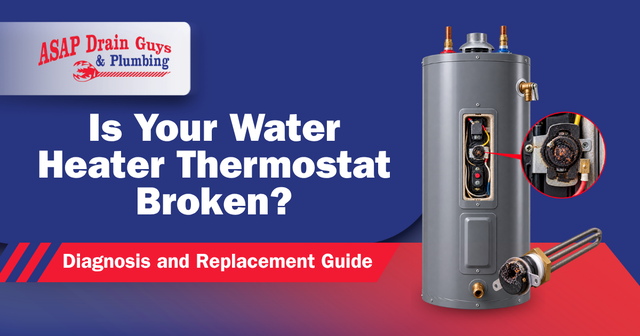
If your hot water faucets run either cold or scalding, your water heater’s thermostat may be to blame. Thermostats control the water heater’s elements, so a faulty thermostat can lead to unpredictable and sometimes dangerous temperatures. Learn more about how to troubleshoot your system and when to call a professional from ASAP Drain Guys and Plumbing for water heater thermostat replacement.
Signs and Symptoms of a Broken Water Heater Thermostat
A broken water heater thermostat usually causes clear signs, such as:
- Scalding water from faucets
- Water heater temperature fluctuating inconsistently
- No hot water or slow recovery times
- Tripped water heater reset button
- High energy bills
How a Water Heater Thermostat Functions
A water heater thermostat regulates the unit’s temperatures to keep hot water within a certain range when it arrives at your faucets. Located on the outside of the tank, the thermostat reads temperatures directly through the metal. Most electric water heaters have two thermostats that operate in sequence — an upper thermostat to prioritize hot water recovery, and a lower thermostat that heats the rest of the tank.
When the water is too cold, the metal contacts in the thermostat stay closed to maintain power to the heating elements. Once the water reaches a set point, usually between 120°F and 140°F, the metal contacts react and open to cut off the power and stop heating.
Safety Precautions Before Testing or Replacing a Thermostat
Water heaters have sensitive components that may risk injuries, equipment damage, and other hazards without the right preparation. Follow these safety precautions before testing or replacing a water heater thermostat:
- Turn off the power from the circuit breaker at the electrical panel.
- Test the thermostat terminals with a non-contact voltage meter or a multimeter to verify that the power is cut off.
- If working with a gas water heater, shut off the primary gas supply valve.
- Make sure the area around the water heater is dry and clear.
- Wear protective gear, such as safety glasses and insulated work gloves to protect against sparks or burns.
Tools Required for Water Heater Thermostat Replacement
In addition to personal protective equipment, gather these tools needed for replacing your water heater:
- Flathead screwdriver
- Phillips screwdriver
- Voltage tester/multimeter
- Needle-nose pliers
How to Test an Electric Water Heater Thermostat with a Multimeter
After completing the safety precautions, including turning off the electricity, follow these steps to inspect your unit complete a water heater thermostat continuity test with a multimeter:
- Step one: Use a flathead screwdriver to remove the access panels, fiberglass insulation layer, and plastic safety cover.
- Step two: Take a photo of the wires connected to the thermostat terminals, then disconnect them.
- Step three: Set your multimeter to the lowest ohms setting.
- Step four: Locate the terminals at each thermostat. Check your owner’s manual for guidance and diagrams.
- Step five: On the upper thermostat, increase the temperature to the max setting, then test for zero ohms at the thermostat terminals for the high-limit switch and heating element.
- Step six: Test the lower thermostat with the multimeter probes. Zero ohms indicate that the thermostat is functioning correctly.
How to Reset the Upper Thermostat High Limit Switch
To reset the upper thermostat high limit switch, look for a red button near the upper thermostat labeled either “reset” or “eco.” With the power to your water heater still turned off, press the button until it clicks. It should stay clicked in — if it pops out, the switch may be faulty, the water in the tank may be at an unsafe temperature, or there may be a problem with the thermostat or heating element.
Step-by-Step Guide to Replacing an Electric Water Heater Thermostat
Learn how to replace a water heater thermostat with these steps:
- Step one: Follow the safety precaution steps — switch off the circuit breaker and verify zero voltage.
- Step two: Remove the outer metal access panel and the fiberglass insulation layer.
- Step three: Snap off the protective plastic thermostat cover
- Step four: Take a photo of the wires, terminal screws, detach leads for reference when reassembling.
- Step five: Slide the old thermostat out of the mounting clips, then replace it with the new thermostat.
- Step six: Reconnect the wires to the corresponding terminals as per your reference photo, set the temperature to 120°F. Reattach the plastic cover, insulation layer, and access panel.
- Step seven: Turn on the circuit breaker at the electrical panel, then wait a few hours for the tank to reheat and to test the temperature.
Gas Water Heater Thermostat Replacement Considerations
Gas water heater thermostats are built into the gas control valve assembly on the tank as a single piece. If the thermostat fails, the entire gas valve assembly requires replacement. Troubleshooting gas water heaters also differ, since these units involve pilot assemblies, thermocouples, gas supply lines, and burner orifices.
Since thermostat replacements for these units involve working with complex gas components, it’s best to rely on a licensed professional. DIY mistakes pose serious risks of gas or carbon monoxide leaks.
Cost of Replacing a Water Heater Thermostat
The cost of replacing a water heater thermostat varies, depending on the unit type, complexity, and additional component repairs. An electric water heater thermostat costs less to replace typically, but the total price can be higher if both thermostats require replacing. Gas water heater thermostat replacements are more complex, require additional safety checks, and require replacing the entire gas control valve.
Replacing the Thermostat vs. Replacing the Water Heater Tank
Replace the thermostat if the water heater is less than 10 years old and doesn’t have any leaks or significant corrosion. Replace the water heater if it’s past its expected service life, heavily corroded, leaking, or otherwise in poor or unreliable condition. Replacing your water heater with a modern unit can improve energy efficiency and overall performance, helping to offset long-term costs.
When to Call a Professional Plumber for Repairs
Call a plumber for repairs if your water heater thermostat troubleshooting is ineffective or if you find signs indicating the need for professional knowledge.
- Gas smells or odors: A smell of rotten eggs near a gas-powered unit may come from a leak — call emergency services, then a 24/7 plumber from ASAP Drain Guys and Plumbing.
- Leaking tank: Leaks or pooling around the tank base indicate that the inner lining and walls are failing.
- Loud sounds: Sediment hardened at the bottom of the tank can cause rumbling or banging sounds.
- Discolored or rusty water: Internal tank corrosion may result in rusty water from your faucets.
- Repeated high-limit switch tripping: If the high-limit switch persistently trips after replacing the thermostat, the water heater may have electrical problems or an underlying faulty component.
Choose ASAP Drain Guys and Plumbing for 24/7 Water Heater Repair
Stuck with a plumbing or drain emergency in San Diego County? Call ASAP Drain Guys & Plumbing right now for 24/7 service with a real person, no hidden surcharges, and $75 off your emergency call!
When it comes to plumbing emergencies, the signs aren’t always as obvious as a burst pipe spraying water across your kitchen. But if ignored, even subtle issues can lead to catastrophic damage, dangerous conditions, and sky-high repair bills. If you notice any of the red flags below, it’s time to stop waiting and call an emergency plumber—before it’s too late.
1. You Hear Water Running—But You Don’t See It
If you hear the sound of water running, but all faucets are off and there’s no visible leak, this could mean trouble is hiding behind your walls or under your floors. Hidden leaks can lead to:
Mold growth
Structural damage
Skyrocketing water bills
This is one of the clearest signs that you may have a burst pipe, slab leak, or deteriorating plumbing that requires immediate professional attention.
2. Sewage Is Backing Up Into Your Tubs or Toilets
If raw sewage is coming up through your drains, tubs, or toilets, you’re not just dealing with an inconvenience—you’re facing a serious health hazard. This is often a sign of:
A blocked main sewer line
Tree root intrusion
Septic system failure
Call a plumber immediately if you see or smell sewage in your home. The longer you wait, the more expensive and toxic the cleanup becomes.
3. You Smell Gas Indoors
Though not technically a plumbing issue in all cases, plumbers are often licensed to detect and repair gas line problems. If you smell the distinct odor of rotten eggs (a gas additive), evacuate immediately and then call:
Your gas company
An emergency plumber to inspect for leaks
Gas leaks can lead to fires, explosions, or carbon monoxide poisoning—do not take chances.
4. You Have No Hot Water
Running out of hot water occasionally is one thing—but if your water heater suddenly stops working, it could point to:
A failed heating element
A leaking tank
A faulty gas connection
Emergency plumbers can quickly diagnose the issue and either repair or replace your water heater, restoring comfort and function to your home.
5. You Can’t Shut Off the Water to Your Home
The water shut-off valve is your home’s last line of defense in a plumbing emergency. If it fails or doesn’t respond, you lose the ability to:
Stop a flood
Control water pressure
Prevent further damage
A plumber can install a new main shut-off valve or repair a malfunctioning one—ensuring you’re protected the next time